“Declarations: Black Americans and the Revolutionary War” includes visuals generated with the help of AI tools to supplement historical depictions. These are based on the work of a fine artist and clearly distinguished in the film by a rough, black frame. Read on to learn more from the filmmakers about why and how they used AI.
Why Use AI?
How do you create a historical documentary centered on the disenfranchised, disregarded, and decentered? As documentary filmmakers, our options have always been limited. The typical route has been archival materials. Archive is often a primary visual tool, but in the case of storytelling centered on historical Black narratives, archive is both limited and limiting.
Portrayals of Black-centered narratives in early American art are few and far between.[1][2] And the ones that do exist were faceless in fields, or caricatured — displayed as subservient property.[3] In “Declarations: Black Americans and the Revolutionary War” we knew we wanted to give our historical subjects agency on visual terms, as never seen before. In doing so, we aim to be a part of a long lineage of artists reclaiming and reshaping Black narratives.[4]
We knew we wanted to have animations, and we knew we wanted to explore new technology, to help us bring these stories to life. We began working with Hudson Campbell, an artist and researcher, exploring the use of generative AI. Together, we created a vision for what this could be, most importantly, rooted in an accurate historical context, while bringing new life to forgotten stories. Campbell’s polymathic skills made him uniquely equipped for the task.
Animations are our chosen medium, and generative AI is allowing us to have a unique, artist-centric approach. We decided we wanted our animations to be based on actual portraiture. Our animator is a skilled fine artist, and he made oil-painting renditions of our four historical subjects. He then used AI tools to animate these portraits, preserving his artistic style while bringing the characters to life. Even for the animations and still images that do not feature the faces of our historical subjects, with time, the programs our animator used generated imagery centered on his own style and artistic vision.
This is not a quick fix. Every rendering goes through hundreds of iterations, and then nearly a dozen rounds of notes amongst the creative team and our expert historical advisors. Our historical advisors include Stephen Seals, a historical re-enactor and staff member at Colonial Williamsburg; Dr. Ed Ayers, a professor and recipient of the National Humanities Medal; and Sam Pollard, an Oscar-nominated and Emmy-award-winning documentary filmmaker, whose work focuses on the Black American experience. We hope that this work will serve as a blueprint for how to use generative AI as a tool, while still being artist-centric, historically accurate, and in line with ethical storytelling practices.
How PBS is Applying Standards to Generative AI Tools
A New Frontier
We live in a moment where rapid technological advancement creates question marks in every sector of society: business and economics, arts and culture — and yes, how we communicate history. “Declarations” explores agency in storytelling: who gets to tell the story? Similarly, we think it’s crucial that artists, documentarians, filmmakers, and creatives across the board seize this moment. How AI tools are used and integrated into our world is not predetermined; we have an opportunity to make sure that cultural curators and changemakers have a say.
We are excited about combining art and technology, not only to spark a conversation around this period in history, but around how generative AI can be leveraged to tell these stories with integrity. We are using AI as a creative tool to tell lesser-known stories in an authentic way, informed by leading historians in the field — filling the gaps in the historical record and visualizing enslaved people with agency and dignity. This is the future, as we hurtle towards a society that integrates AI, it is crucial that we as artists, educators, and historians learn to deploy this tool in ethical ways that enrich our storytelling.
Step-By-Step
Towards the end of the film, Abraham Skipwith gets his freedom through legislative petition. There is very little to depict this moment in the historical record, so we created an animation. Throughout the film, our artist and researcher, Hudson Campbell, created animations using the portrait he painted of Abraham Skipwith to inform body type, appearance, and context. He also did research about contextually appropriate clothing. At first, Campbell created an animation where Skipwith received his manumission papers at his home. But historian Stephen Seals pointed out that this more likely would have happened in an official government office or courthouse. So, Campbell used AI tools to generate this still:
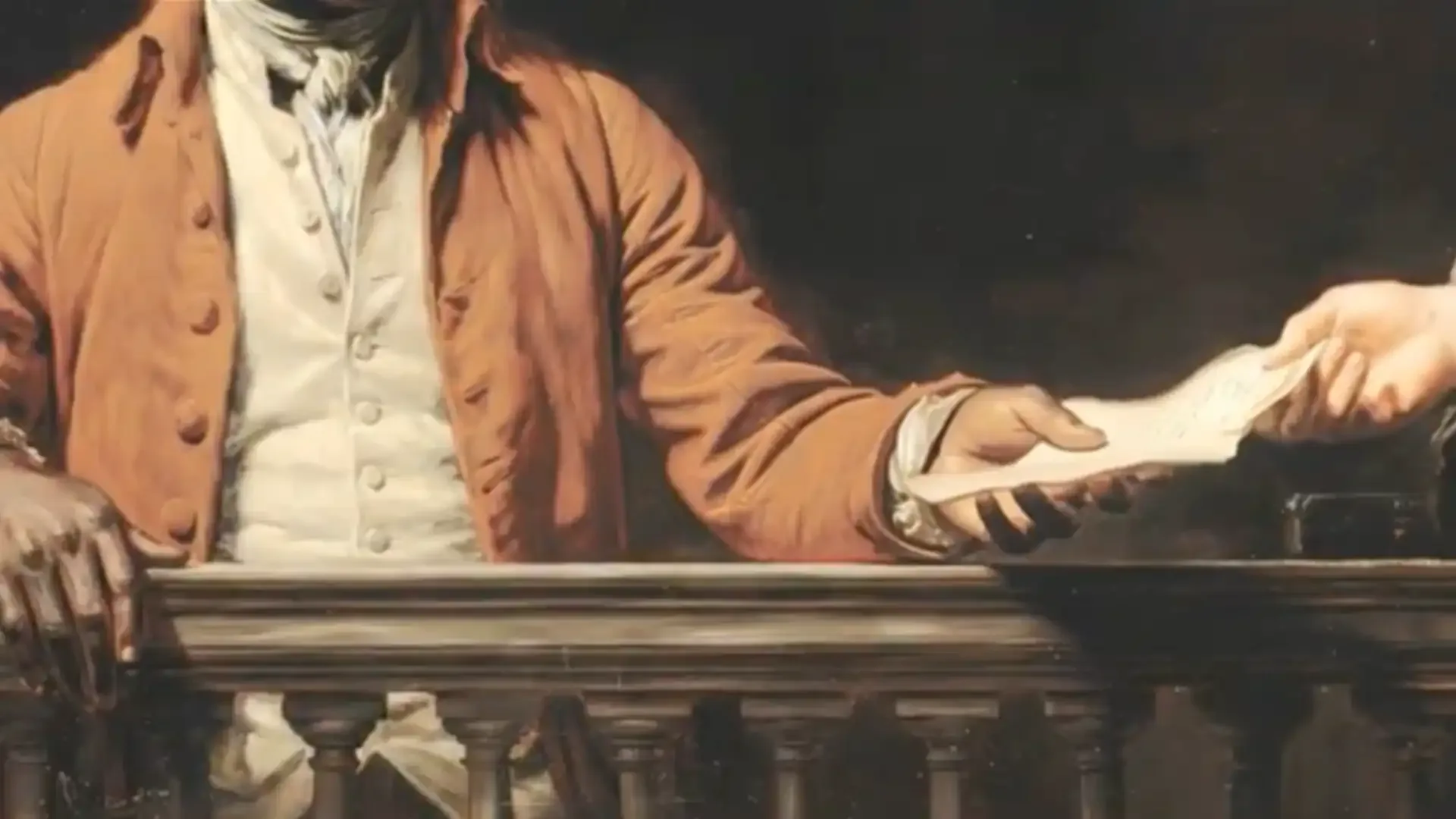
While this was more historically accurate, it needed to be more visually consistent with the rest of the generative AI in the film and match Skipwith’s clothing and color scheme throughout the film. A new version was created:
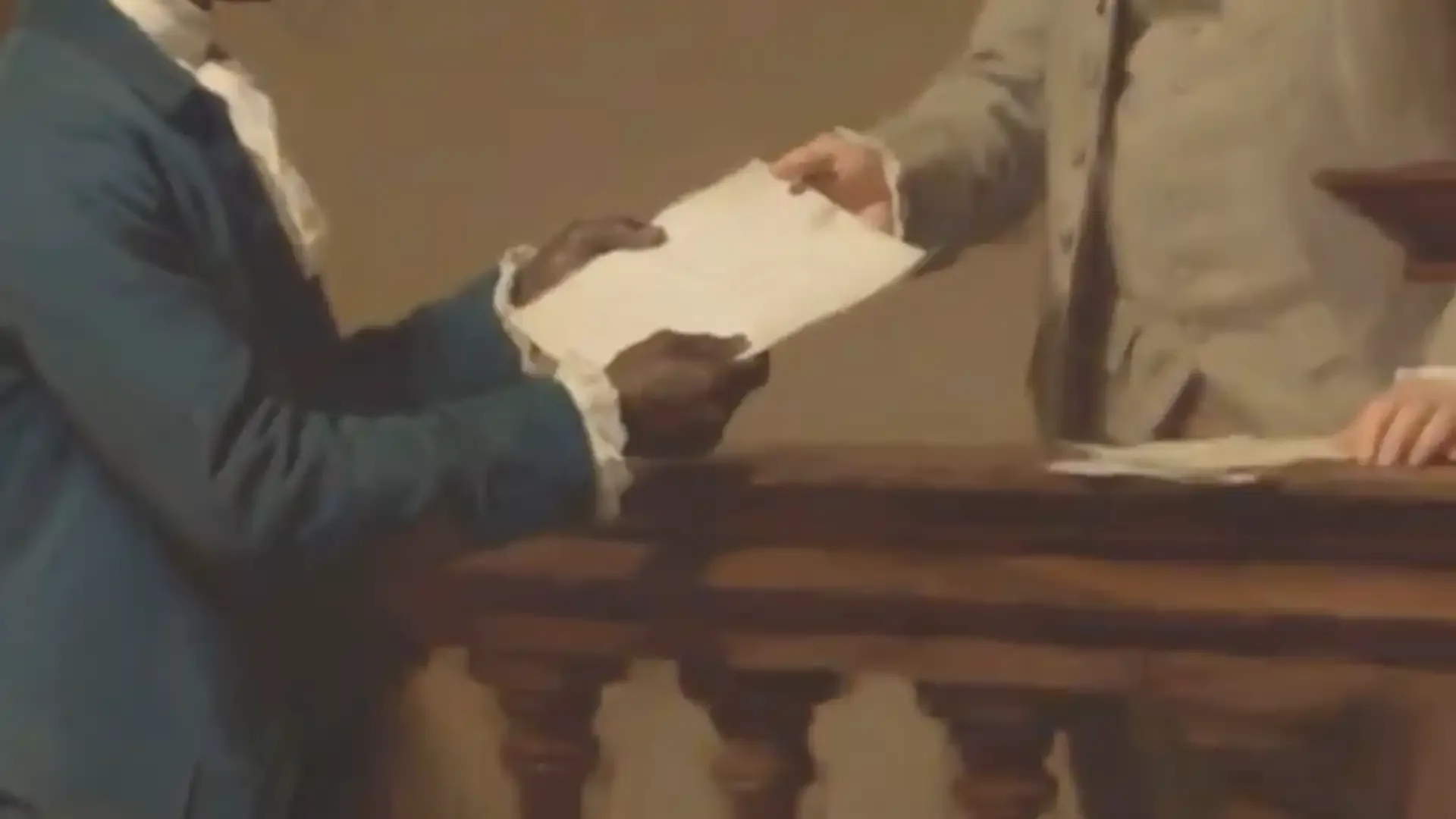
Stylistically, this hit the mark, but our historical advisor Stephen Seals pointed out that the sleeves were ruffled, and they would not have been. The visuals were further revised, and below is a still from the animation you will see featured in the film:
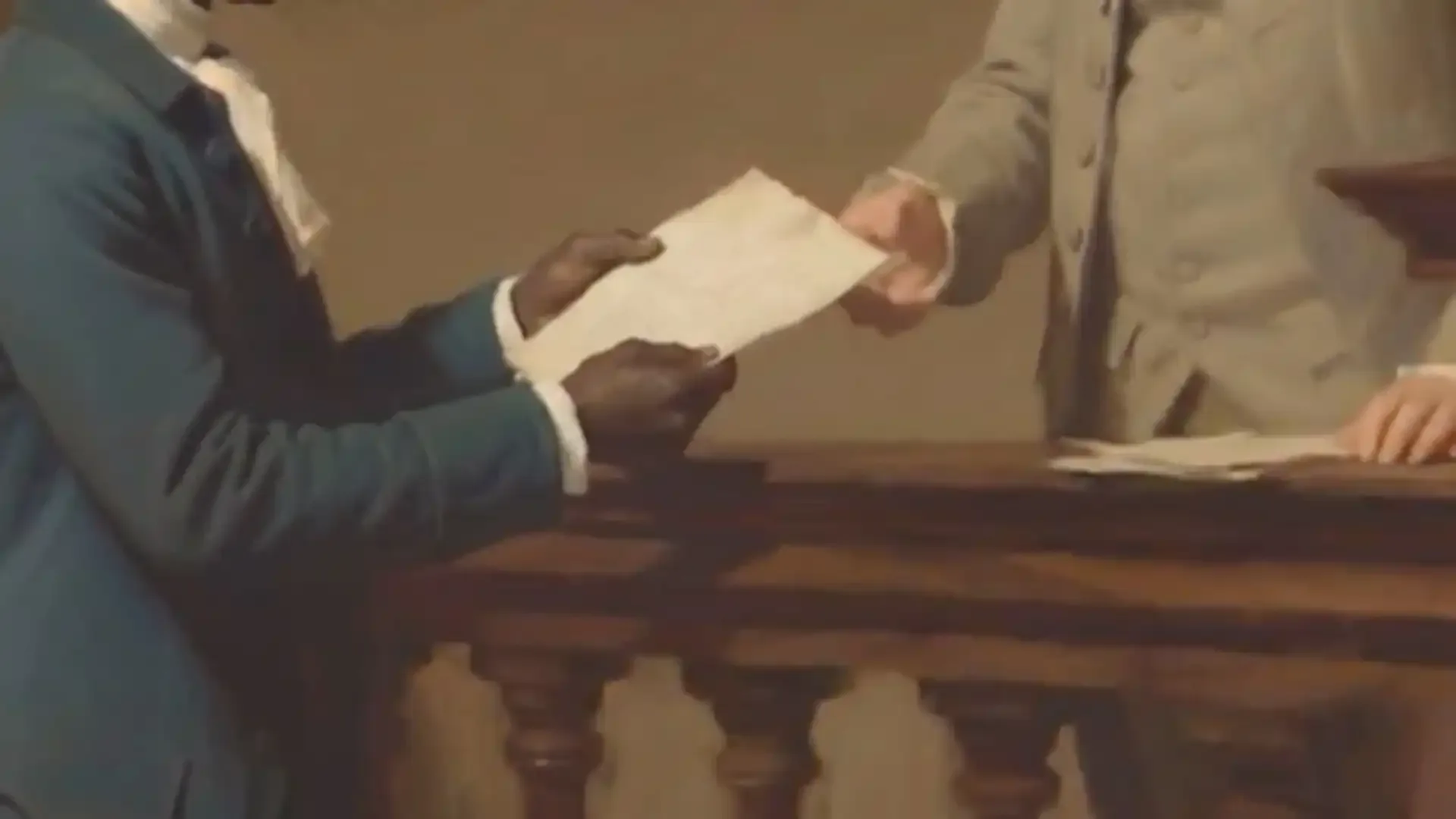
This was approved both creatively by the production team, and historically by our expert advisors. Importantly, it brings life to a moment rarely visually captured in the historical record: The moment an enslaved person becomes free.
Notes from Our Experts
My work examines how the past informs the future, exploring the evolution of both the stories being told and the mediums used to tell them. In my classical artwork, the tactile elements of oil paint and linen canvas serve as a reminder of permanence, grounding my work in historical tradition. Drawing from my background in archival producing, I use research to translate the profound experiences of historical figures and the environment they inhabited into visual manifestations. By integrating generative AI into this process, I bridge the centuries-wide disconnect between these figures and modern viewers, breathing dimension into the past and making history intimately relatable.
— Hudson Campbell
Campbell has a B.A in Fine Art from Pepperdine University. He has a background in graphic design, but pivoted into the documentary space, working as a researcher and archival producer. He has been an associate archival producer on three PBS series: “Gospel,” “Black and Jewish America: An Interwoven History,” and “Great Migrations: A People on the Move.”
As someone who has wrestled for decades with ways to represent people from the past denied a rich documentary record, I was struck by the beauty and humanity of the AI-generated art in your presentation. Especially powerful, I thought, were the ways the figures met our gaze, inviting human connection. While I am sympathetic, of course, to those who resist the displacement of human-generated art (and words!) by AI, in this case the AI enhances rather than replaces art created by an artist. Especially given the paucity of representations of Black Americans in the era of the Revolution, the use of AI here seems especially fitting as you tell your deeply human story.
— Dr. Edward Ayers
Edward Ayers is Tucker-Boatwright Professor of the Humanities at the University of Richmond, where he is President Emeritus. President Barack Obama awarded him the National Humanities Medal in 2013, hailing his “commitment to making our history as widely available and accessible as possible.”
For those of us who dedicate our lives to telling the stories of our people, it’s often disheartening to run into the same road blocks over and over again during our research. When a people are simply trying to survive, they aren’t concerned with writing down how they did it. We’re often dependent on the few white individuals who decided to describe what they saw. And even more often, what they describe, as an outsider, does not actually match what is actually happening. Biases seep in and very easily can become the history. As a tool, AI has the ability to allow us to see our history with a perspective that comes from our cultural understanding. History is our identity. Being able to see history through a more nuanced point of view makes it all the more true to the experiences of those who actually went through it. I’m very pleased with how AI was used in this production and the power that these images portray.
— Stephen Seals
Stephen Seals is the director of Curated Programs at the Colonial Williamsburg Foundation and portrays Nation Builder James Lafayette at Colonial Williamsburg for more than a decade.