It’s no secret that technology has advanced throughout the seasons of Call the Midwife and has continued barreling forward until the present day. Some interventions have been groundbreaking, such as the ability for babies born at earlier and earlier gestations to survive.
We have electronic medical records that allow someone’s health information to be easily viewed between hospitals or care locations. We even have access to virtual healthcare appointments or consults. The rise of technology has improved the way we provide healthcare in so many ways (even if we all complain about the amount of charting and clicking we still have to do!).
Having the internet always at our fingertips has given us access to unlimited amounts of information, which isn’t always a great thing. We now know everyone’s opinions on every matter, and along with these opinions comes a LOT of judgment. One influencer might boast about making all of her family’s food from scratch, while another shames her for demonizing certain foods.
One area where you can certainly find a lot of judgment is the birth world.
I have followed accounts for many different birth workers (midwives, doulas, OB/GYNs, lactation consultants) for years now. Birth work is a part of who I am. I have always loved reading birth stories, learning new techniques or tips to help my practice, and staying up to date on what evidence is currently recommended.
More and more lately, though, I find myself scrolling past, or even unfollowing, many accounts that take on a very judgmental tone when it comes to birth.
The one thing to really understand about birth is that there is no “one size fits all” right answer. There is not one “best way” to give birth. However, if you spend a few minutes scrolling through the birth algorithms of your favorite social media apps, you’ll find a lot of information telling you that “natural” birthing is definitely the best. Unmedicated births are the way to go. You won’t bond with your baby unless you don’t get the epidural! Definitely don’t take the IV pain medication or your baby won’t know how to latch. Birthing at home is clearly the best environment. Hospitals are only out there to coerce you into interventions you didn’t want, and they inherently make birth less safe, and definitely less sacred.
This type of binary thinking that one way of birthing is “better” than the other is harmful for everyone in the long run because, like everything else in life, there’s not just one right and one wrong answer for how and where someone should birth. There’s not even one idea that homebirth “always” looks one way and hospital birth “always” looks another way. There are wonderful home birth providers, and terrible ones. There are wonderful hospital birth providers, and terrible ones. There are both beautiful and tragic stories on both sides.
I am not anti-home birth. In fact, I always dreamed of having a home birth for myself! That’s not the way my births ended up happening (I had gestational diabetes and birthing in the hospital was the safest environment for me), but I have attended friends’ home births, and they were absolutely beautiful and magical. I’ve also attended hundreds of beautiful, magical hospital births. I’ve attended some really stressful ones, too, and plenty that didn’t go the way everyone had hoped for.
In my current practice, we see a good mix of very low-risk, healthy pregnant people, as well as moderate to high-risk pregnant folks (where we would likely co-manage their care with Maternal-Fetal Medicine or our OB/GYN physician team). Rarely, someone can risk out of midwifery care, just like how sometimes women on Call the Midwife are referred out for care when needed.
The Nonnatus House midwives make recommendations for people to birth at home, at the maternity home, or at St. Cuthbert’s. In my current practice, we will make recommendations about things like the timing of birth versus what we call “expectant management,” which is watchful waiting. In certain pregnancy-related complications, like diabetes, high blood pressure, or other health problems, we might recommend induction of labor at varying gestational ages based on what our current guidelines are, and how the patient’s and baby’s health have been progressing.
In a low-risk pregnancy, we might offer induction of labor around 41 weeks or plan for extra testing to make sure mom and baby are safe if they would prefer to wait until 42 weeks. Our practice doesn’t offer home births or birthing center births, so the location of delivery is not usually a huge change unless there is a condition requiring the baby to be born at a hospital with a higher-level NICU facility.
I became a midwife because I wanted to honor birth as a natural part of the human life cycle. I felt like the way obstetrics had been moving was a little too far in the wrong direction, and I really felt like I could make a difference in people’s lives by helping them have a more physiological birthing experience. I could help women and birthing people feel heard, and help make this amazing, transformational life event something that they would hopefully look back on with joy and empowerment.
I’ll admit, as a newer midwife, I probably was a little starry-eyed and definitely held stronger opinions about always doing things “as naturally as possible.” I think as I head toward 14 years of experience (!!!), I have learned so much more about the nuances of this work. There is a time and place for medical interventions. It’s not in the healthy, low-risk, spontaneous labor, but it might be in the planned induction for preeclampsia.
I’ve also learned that needing a medical induction doesn’t mean that your birth plan or birth environment goes out the window. There is still so much that we can hold onto: dim lights, soft music, movement when it is safe to do so, planned skin-to-skin contact, and delayed cord clamping. Shared decision-making is a cornerstone of midwifery care — and always will be.
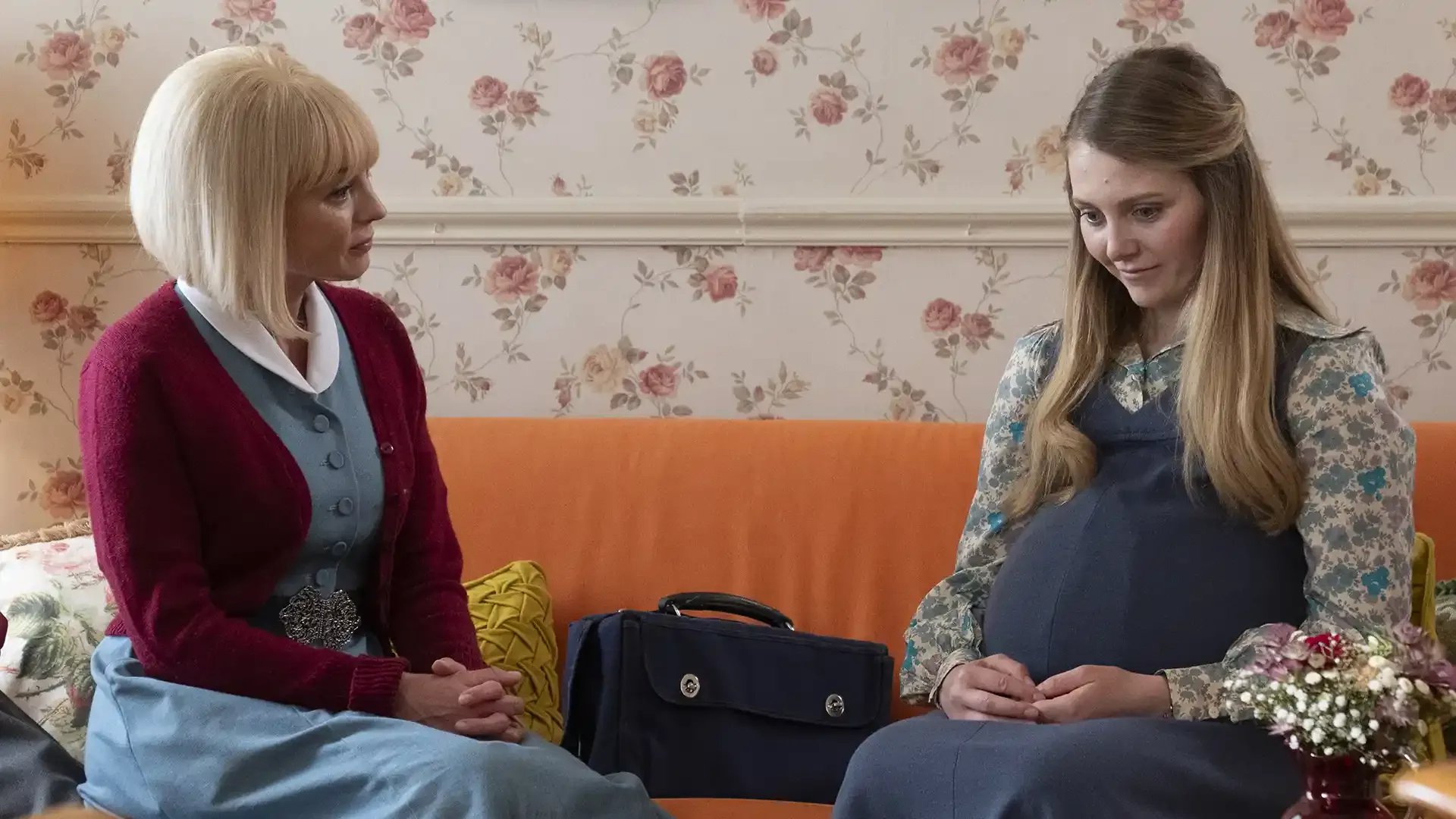
In episode 2 of Call the Midwife, we met sisters-in-law Hope and Estelle Glennon. They were due just days apart and were each other’s main support during pregnancy. Hope was having her second baby, and Estelle was having her first. After Hope had a very challenging labor and birth, along with a shoulder dystocia, Estelle was extremely traumatized. Trixie realized that Estelle had already been through a lot of trauma in her life, and seeing Hope go through that painful of a birth with complications left her terrified of her own birthing experience.
Trixie had been in New York City, though, and she had learned of technology available to birthing women called an epidural. An epidural involves using a needle to find the epidural space in the back and inserting a catheter into that space, similar to how we start an IV. The needle finds the space, then is retracted, and a small, flexible tube is left in place. Medicine can be given into the epidural space that causes numbness from the point of insertion downward.
While epidural anesthesia has been tweaked over time, and now we don’t aim for complete numbness, the idea is the same. Epidurals can offer wonderful pain relief during the labor process. Trixie felt strongly that Estelle would benefit from an epidural during labor and wanted to look into a way to make that possible for her.
Dr. Turner had heard of epidurals but had never seen one in practice. He knew they were not yet offered at St. Cuthbert’s Hospital, but he wondered if he could speak to the anesthesia team and see if this could be a possibility.
I love how Trixie and Dr. Turner collaborated and had a shared goal of helping Estelle have the most peaceful, empowering birth possible, along with minimizing any further trauma. Even though Dr. Turner initially seemed skeptical, he listened to Trixie, who had more experience with epidurals than he did.
The team at St. Cuthbert’s was also on board, and, as soon as Estelle went into labor, they transported her to the hospital, where she was given an epidural. As her pain dissipated, the relief on her face was palpable. Even Dr. Turner was in awe of someone able to birth without feeling labor pain.
Dr. Turner realized at that moment that the birth world was changing. Having epidurals readily available would change the way many women wanted to birth, which would definitely impact how many women decided to birth at home or at the maternity home.
Today, the majority of women in the United States give birth in a hospital with an epidural for pain relief. I still see a great number of women who seek out midwifery care because they are looking for a more physiologic, holistic approach to pregnancy and childbirth. Some people seek me out for care because they would like to avoid interventions and an epidural during labor. I went into my first birth with the same idea — let things progress as naturally as possible and avoid pain medication and an epidural. And then my labor happened!
It was a long labor, which started with my water breaking. After 12 hours of regular contractions every five minutes, I was two centimeters dilated. I was vomiting every 30 minutes. After six more hours, I was 3-4 centimeters. I was exhausted. I needed rest. Cue the epidural!
As I started to feel the warmth and numbness flood my lower body as the epidural settled in (they gave me a combined spinal-epidural so it would work quickly), I started crying. I was a little sad that I had “caved” and gotten an epidural, but I also think I was more relieved. I could relax for the first time in over 18 hours. I could feel joy again that today was the day I was going to meet my baby. I could get the rest I needed so I would have the energy to push my baby out. The epidural was the right choice for me during that birth.
You don’t have to be a “crunchy” mom to benefit from a midwife’s care. Whether a patient wants an unmedicated birth or knows they’ll want an epidural from day one, my goal remains the same: to help them feel empowered and safe as they navigate their own unique journey. I loved seeing this play out on Call the Midwife this week.
When Trixie — a midwife herself — suggested an epidural for Estelle, it was a perfect example of meeting a patient where they are. It was a beautiful display of interdisciplinary support, proving that an empowered birth looks different for everyone.